

What Is Gonstead Chiropractic? A Whitefish Chiropractor Explains the Difference

If you've searched for a "Gonstead chiropractor near me" or you've been referred to Two Sparrows Family Chiropractic and aren't sure what makes Gonstead different from the chiropractic care you've had before, you're not alone. Gonstead is one of the most thoroughly researched and widely taught chiropractic systems, but it's also one of the least understood by patients — mostly because it looks different from what most people picture when they think "chiropractor."
Here's what the Gonstead technique actually is, how the analysis works, and why we built our entire practice in Whitefish around it.
At Two Sparrows, we've built our entire practice around Gonstead chiropractic — not as one of several techniques we offer, but as the only one. We have been in practice for 7 years, and we've been Gonstead-exclusive since we opened in 2020. Our Gonstead training came through the Gonstead Methodology Institute, the Troxell Intern Program, and countless hours in other seminars that touch on Gonstead.. We didn't choose this system because it's the easiest to run a practice on — it's more demanding, both to learn and to perform correctly. We chose it because the level of precision it requires matches how we wanted to practice, and it produces incredible results for patients because of the specificity of the care provided.
What Makes Gonstead Analysis Different
Before ever placing a hand on a patient, a Gonstead-trained doctor works through a specific, structured evaluation process. This isn't guesswork or a generic "crack wherever it feels tight" approach — it's a system built to identify exactly which vertebra is out of alignment, in which direction, and why, before any adjustment is made.
This analysis typically includes:
Visualization — observing posture, gait, and visible asymmetries as the patient moves and stands
Static and motion palpation — feeling the spine both at rest and during movement to detect restricted or misaligned segments
Instrumentation — using a handheld temperature-reading instrument (a nervoscope) to detect areas of inflammation along the spine, which can indicate nerve interference
Full spine X-ray analysis — when clinically appropriate, taking weight-bearing X-rays to see the spine's actual structure and alignment, not just guess at it from the outside
The two tools that really change how we see things are our instrumentation and our x-ray.
I’ll start with instrumentation, the temperature differential device that we use is called a Delta-T. When there is a nerve pressure in the spine, there is inflammation of that disc - and the heat from that inflammation shows up on the surface of the skin. The Delta-T helps us find that heat change, so we can further investigate if that indeed is an area that needs attention. A long winded way to say that it takes the guess work out of the picture!
With x-ray - we never pursue a diagnostic that wouldn’t change the course of care we provide. Meaning, that x-rays are incredibly useful for us in figuring out where the problem areas are, how long they’ve potentially been going on for, and it helps us rule out anything more severe. There have been many times where we’ve found old compression fractures, spondylolithesis, and old whiplash injuries. In these cases, it’s changed the course of our care, and we wouldn’t have known that unless we took the x-ray!
Why Precision Matters
A misalignment (what Gonstead practitioners call a subluxation) doesn't always happen at the spot where a patient feels pain. Adjusting the wrong level, or adjusting in the wrong direction, can fail to resolve the issue — or in some cases make a patient feel temporarily worse before better. Gonstead's structured analysis is designed to reduce that guesswork by identifying the actual source of the problem, not just the area that hurts.
Precision matters most when the timing is working against you. We see it every November and December — skiers who spent the summer sitting at a desk, then jump straight back onto the mountain, and show up with low back or SI joint pain that didn't come from any one bad run. It built up from months of sitting followed by a sudden return to load-bearing, twisting movement, and a general adjustment across the low back often doesn't hold because it was never aimed at the actual segment carrying that strain. A Gonstead analysis is built to find that segment specifically, rather than treating the whole area the same way.
Full Spine Digital X-Rays
Not every patient needs X-rays, and we'll walk you through that decision together. But when X-rays are clinically indicated, Gonstead practitioners use full spine, weight-bearing films — meaning you're standing, under normal gravitational load, rather than lying on a table. This matters because a spine imaged lying down can look different than it does under the weight and posture it actually carries all day. Full spine views also let us see how alignment in one area of the spine may be compensating for — or contributing to — issues in another.
The History Behind the Technique
Gonstead chiropractic was developed by Clarence Gonstead, D.C., starting in the 1920s. Gonstead was known for an almost obsessive commitment to precision — he wanted to know exactly what was happening in a patient's spine before ever making an adjustment, rather than relying on general patterns or assumptions. Over decades of clinical practice, he refined a system of analysis and adjustment that's now taught in chiropractic programs and postgraduate seminars worldwide, and it remains one of the most extensively documented technique systems in the profession.
The 5 Criteria of Gonstead Analysis
Gonstead-trained doctors are taught to evaluate the spine using five specific criteria before determining where and how to adjust:
Visualization — observable posture and movement patterns
Instrumentation — thermographic (temperature) readings along the spine
Static palpation — feeling the spine at rest for misalignment, swelling, or tenderness
Motion palpation — assessing how each segment moves (or doesn't move) through its range
X-ray analysis — when appropriate, using full spine films to confirm structural findings
Using multiple criteria together, rather than relying on just one, is meant to reduce the chance of missing — or misidentifying — the actual source of a patient's symptoms.
Why Some Patients Prefer This Level of Precision
Patients who've had general chiropractic care before sometimes tell us the Gonstead approach feels more thorough — because it is more thorough by design. Rather than a broad, non-specific adjustment across several spinal segments, Gonstead care is built to identify and correct the specific segment causing the problem.
Comparing Gonstead to Other Common Chiropractic Techniques
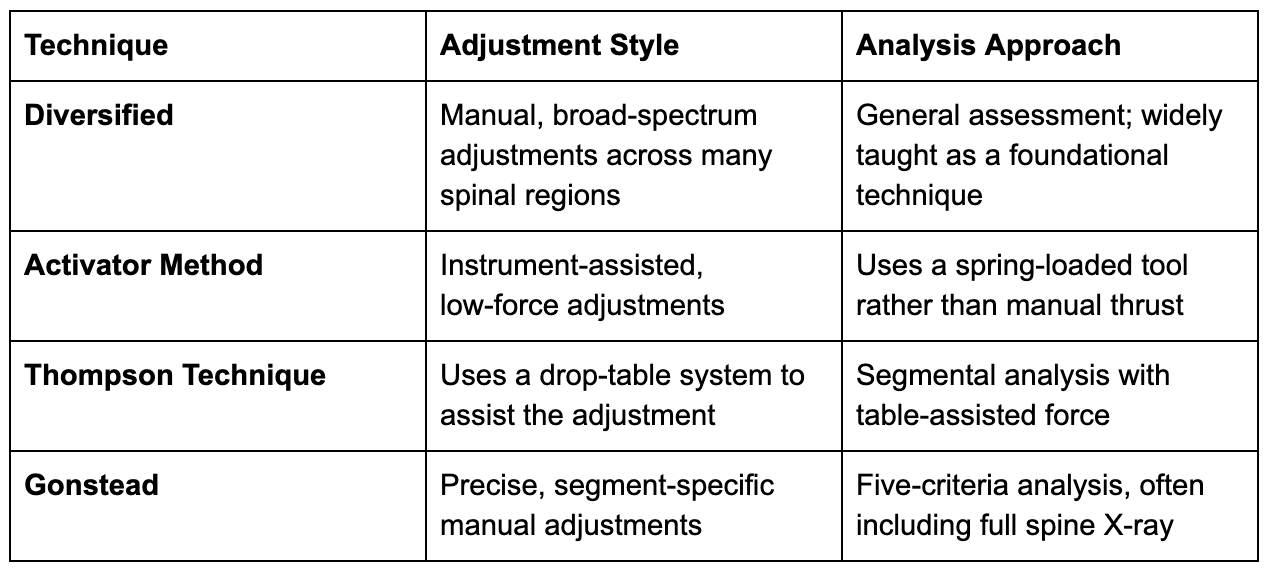
Each of these techniques has research behind it and a place in chiropractic care. Gonstead is distinct primarily in the depth of analysis performed before any adjustment is made, and its structural, biomechanics-first approach to identifying the problem.
Why Full Spine X-Rays Are Central to Gonstead Specifically
Other techniques may use X-ray selectively or not at all. Gonstead's approach treats full spine, weight-bearing X-ray as a core diagnostic tool (when clinically appropriate) because it shows structural relationships — like disc spacing, spinal curves, and pelvic alignment — that can't be reliably assessed through touch alone. This is part of why a Gonstead exam can look and feel more thorough than what many patients have experienced with general chiropractic care.
What to Expect if You've Only Experienced Other Techniques
If your prior chiropractic care involved a quick assessment and an adjustment across several areas in one visit, a Gonstead exam may feel different from the start. Expect a more detailed history, a hands-on motion and static palpation exam, possible X-rays if clinically indicated, and adjustments focused specifically on the segments the analysis identifies — rather than a broad adjustment across the spine.
Care Built Around You
We've never been comfortable with the "just trust the process" approach to care, and that's a big part of why we practice this way. When we adjust you, we want you to actually know what we found, which segment we're correcting, and why — not just take our word for it. That's the whole point of the analysis: it gives us something real to explain, instead of a guess we're asking you to have faith in.
If you've been curious about what a Gonstead exam and adjustment actually involve, we're happy to walk you through it — no obligation, just a real conversation about what we find and whether Gonstead care makes sense for you.
Book your visit online or call (406) 249-6312.
This article is for informational purposes and is not a substitute for individualized medical or chiropractic advice.
Follow Along!